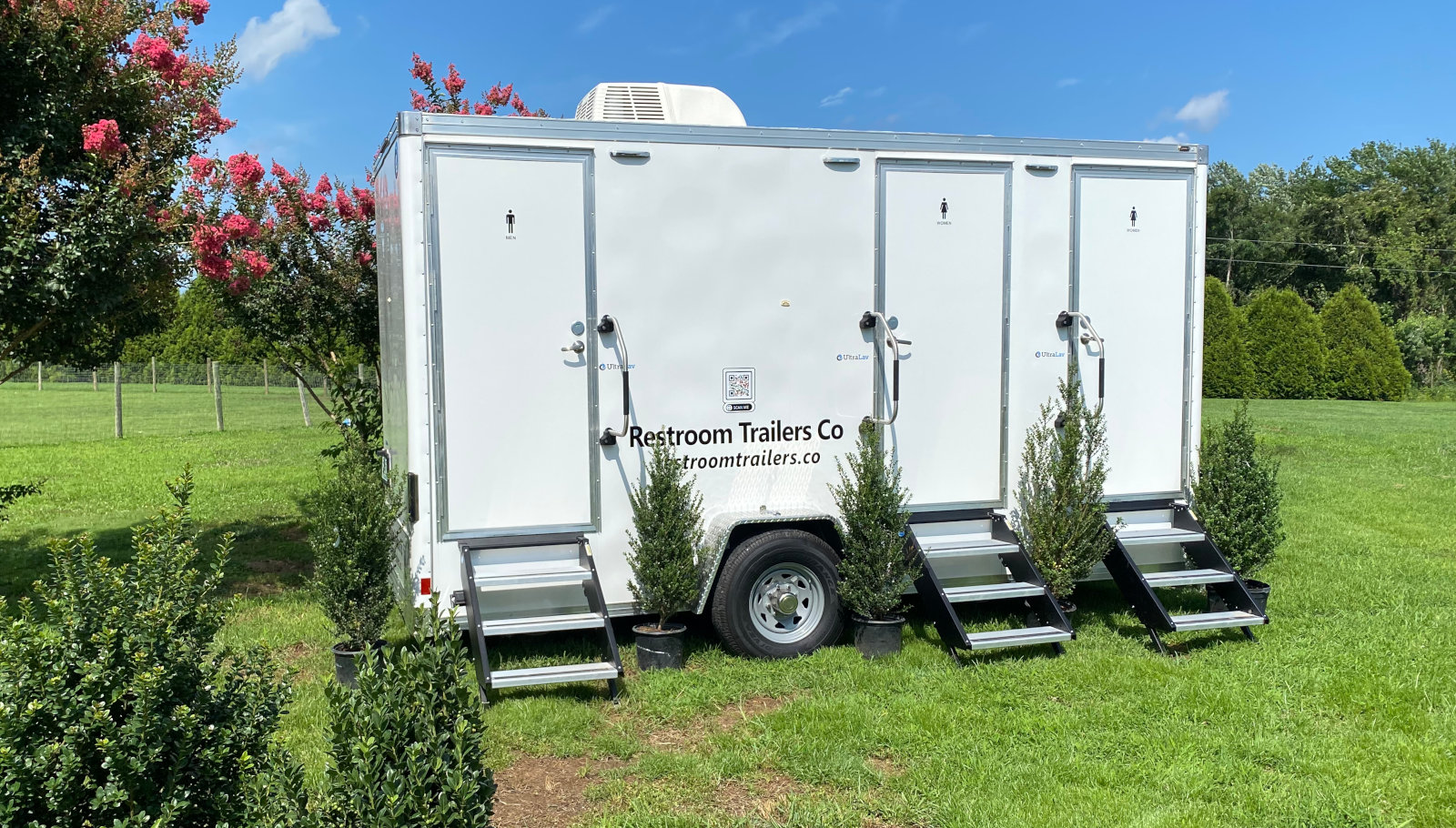
Outdoor events do not stop when the weather turns. Trunk-or-treats, fall festivals, tree lightings, holiday markets, and company parties in barns and tents all run from late October through New Year’s, and most of them happen on a site whose permanent restrooms were built for a much smaller crowd.
A heated trailer is a different piece of equipment than a plastic unit in a parking lot. Cold and early darkness also change the plan in four specific places: how often guests go, how the unit stays warm, what freezes, and where you can safely put it.
The Events This Season Brings
Trunk-or-treats and Halloween nights. Churches, schools, fire companies, and businesses put these on in a field or a parking lot. The whole family comes, not just the kids, so the crowd runs well past the number of cars signed up to hand out candy. Kids are in costume, parents are standing around in the dark, and the nearest bathroom is usually locked inside a building nobody wants to open.

Fall festivals, harvest days, and craft fairs. Long dwell times. People walk a vendor row, eat, and stay for hours, which puts far more use on a restroom than a parade that empties out in forty minutes.
Tree lightings, holiday markets, and parades. Short and dense. A few hundred people arrive inside the same twenty minutes, and they all want the restroom at the same two moments, right before it starts and right after it ends.
Holiday parties in barns, tents, and venues. A rented barn or a tent behind a house is the classic case of a beautiful site with one bathroom. Guests are dressed up. Walking to a plastic unit in the cold in December is what people remember about the party.
Cold Makes People Go More Often
Cold weather increases how often people need a restroom. It has a name, cold diuresis. When it is cold, blood vessels near the skin narrow to hold heat in the core. That raises the pressure in a smaller circulating volume, and the kidneys shed the difference. The same crowd that was fine with two stalls at a July festival will line up at a November one.
Plan more capacity per guest in the cold, not less. Alcohol at a holiday party pushes the same direction.
What the Heat Actually Is
Our trailers are climate-controlled, and in the cold months that means a thermostat-controlled electric wall heater inside the unit rather than a vent blowing outside air around.

Two useful things follow from that plate. First, 4.2 amps is a small draw, so heat is not what decides your generator size. Second, a heater that size warms an insulated trailer steadily rather than instantly, so the unit wants to be on site and running before guests arrive, not switched on as the first car pulls in. Tell us what time doors open so the delivery can be scheduled around warming it up.
Water and Freezing
The other half of cold-weather planning is water. Fresh water lines and tanks freeze, and a frozen line is the failure that ends restroom service for the night with no way to fix it on the spot.
What to tell us when you book a date between November and March:
- Whether the site has power, and what kind of outlet.
- Whether the trailer sits overnight, and how cold the overnight low is expected to be.
- Whether anyone can be on site to keep the unit running between event days.
Those three answers decide how the unit gets set up, serviced, and winterized for your date. Getting them right at booking is far easier than fixing a freeze at seven in the evening.
Dark at Five
By the end of October the Eastern Shore is dark before dinner. Everything about restroom placement changes when guests are walking to it in the dark.
- Light the path, not just the unit. Interior lighting is standard in our trailers. What organizers forget is the thirty feet of grass between the trailer and the event.
- Watch the extension cords. Anything you run across a walking path in the dark needs a mat or a tape line over it.
- Keep the walk short. A hundred feet in July is nothing. The same hundred feet in a coat, in the dark, on wet grass, is why people leave early.
- Think about where the truck can get in. Fall fields are soft, and frost heave and mud both decide where a trailer can be placed and pumped. Firm ground close to the crowd beats perfect ground far from it.
Booking
October and December are the two months to ask about early. Halloween and New Year’s Eve are single dates, and one event gets each of them. If you are working on a fall festival, a trunk-or-treat, or a holiday party, get the date on the calendar early and work the details out after.
More on multi-day and crowd-flow planning is in the Festival & Fair Restroom Planning Checklist, and the festivals and fairs page covers what we stage for larger public events.